
An Elysium London Webinar Series. Convened by Muhammed Rauf. Elysium London.
Inclusive research and community research get used to mean very different things. Session one set out working definitions of both, placed them on Arnstein’s ladder of citizen participation, and closed on three questions that show where any project really sits: who holds the resources, who makes the decisions, and whose outcomes come first.
The recording is the taught hour, from the live session on Wednesday 11 November 2026. Use the chapters to go straight to a definition or a case study, or search the transcript for any word and the video jumps to it.
Where does your project sit?
Think of a project you are working on, or the last one you finished. Answer for what actually happens in it, whatever it is called. Nothing you choose here is saved or sent anywhere.
What the room said
You have placed your own project. This is where the room placed theirs, and what they said.
The word you used for your last project
As written. Gold marks the seven words that described how the work felt.
Where your last project sat
Run through the three questions. 13 responses.
The quiz: which definition is right?
Every answer was a recognised definition. Some people picked more than one.
Engagement 12 people
Involvement 13 people
Participation 16 people
One thing you’d change
For your next project. 11 responses, as written, with names removed.
- “More feedback and learning sessions on the joint research process”
- “Community ownership and continuity”
- “Take a view about the power relationship”
- “Start with the community power arrangements and giving resources directly to groups”
- “More followups and update on the project progress.”
- “shared decision making of what comes next”
- “Confirm the power sharing arrangements”
- “Effective feedback of impact of insight to those who gave it as standard”
- “Nothing. It was great. Albeit doomed.”
- “Including community members in reports and outcomes more explicitly”
- “Train community researchers and academics on how to work together”
These numbers come from one room, so they are a starting point for the sessions that follow.
The working definitions
Every term here takes a position on power. Each definition has its own link, so you can send a colleague or a partner straight to the one you mean. The full definitions sheet is in the materials below.
Inclusive research
An equity-centred, partnership-based approach to generating knowledge that restructures who participates, how decisions are made, and whose knowledge counts.
Equity-centred means changing the structural conditions under which people take part. At its best it reaches delegated power: communities lead a whole workstream, while the institution holds the award.
- Resources
- A research organisation, shared.
- Decisions
- Shared at each stage.
- Outcomes
- Shared priorities.
Co-production
A partnership in which communities and researchers share decisions, resources and responsibility across the whole research life cycle, recognising community knowledge as equal to academic expertise.
In line with NIHR’s co-production guidance, where everyone’s knowledge is “afforded equal respect and value” (2021).
- Resources
- Shared, at least in part.
- Decisions
- Shared at every stage.
- Outcomes
- Agreed together.
Co-design
Communities and professionals designing something together, with communities sharing power over how it is designed, though not necessarily over what happens next.
In the literature, co-design usually means a creative process at the design stage (Vargas et al., 2022).
- Resources
- The institution.
- Decisions
- Shared, inside the workshop.
- Outcomes
- Not necessarily theirs.
Community research
Research that starts from community experience and priorities, with people affected leading the research and deciding how resources are used.
Power claimed and held: the community organisation holds the funding. Much of the sector calls this community-led research. Communities hold all three.
- Resources
- The community organisation.
- Decisions
- Communities.
- Outcomes
- The community’s.
Community-centred
Research centred on community experience, with people affected delivering the research and influencing how resources are used.
It has real value. Much of what is called peer or community-led research sits here. Public health uses the term more broadly (South, 2015).
- Resources
- Influenced.
- Decisions
- Shared, at best.
- Outcomes
- Often the institution’s.
Community-informed
Research that seeks the views of communities affected by the issue under study, with the institution leading the research and deciding how resources are used.
Often called community-engaged research, a wider term that runs from outreach to shared leadership (Principles of Community Engagement, 2011).
- Resources
- The institution.
- Decisions
- The institution.
- Outcomes
- The institution.
The sector’s terms: check which one your partner means
These are not our definitions. Their meaning depends on who is speaking, so check which one your funder, team or partner means, write it down, and agree it at the start.
| Term | What NIHR means | What others mean |
|---|---|---|
| Engagement | “Where information and knowledge about research is provided and disseminated” (NIHR Briefing notes, 2021, updated 2024). | A two-way process (NCCPE). An umbrella that runs all the way up to co-production (NICE NG44, 2016; NHS England, 2022). |
| Involvement (PPI) | Research carried out “with” or “by” members of the public, rather than “to”, “about” or “for” them. | Level 3 of 5 on the IAP2 spectrum used by many councils. In NHS law, the duty to involve can be met by consulting people or giving them information (NHS Act 2006, s.14Z45). |
| Participation | Taking part in a research study. | Taking part in decisions (NHS England, 2022). For Arnstein (1969), “a categorical term for citizen power”. |
| PPIE and its cousins | PPIE, PPIEP, CEI and now public partnerships. Their scope varies between NIHR centres: some add participation, some do not. | PPI is exposed “to criticisms of exclusivity and tokenism” (Ocloo and Matthews, 2016). |
| Research inclusion | An NIHR condition of funding since November 2024: inclusion designed in from the outset, as a costed part of the award. | About who takes part. On its own, it does not settle who decides. |
The materials
Use and share them freely, with credit to Elysium London.
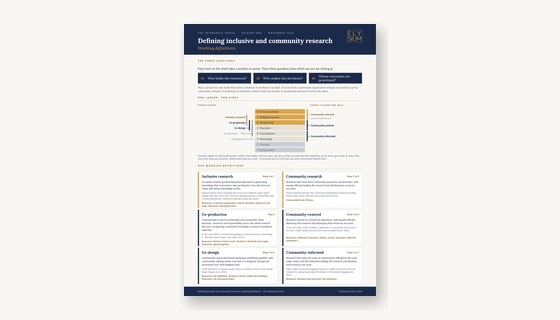 Definitions sheetPDF · 2 pagesWorking definitions of inclusive and community research, and the three questionsDownload the sheet
 SlidesPDF · 40 slidesThe deck from the taught hour, with its sourcesDownload the slides
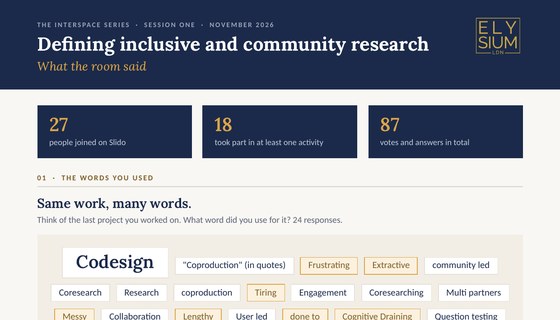 What the room saidPDF · 2 pagesEvery Slido result from the session, shared without namesSee the results
The studies and sources
Mothers’ photographs from the Indian Sundarbans: Ghosh, Bose, Bramhachari and Mandal (2016), BMC Health Services Research. The inclusive research case from part two.
Rebuilding Trust through Community Engagement and Empowerment: Centric Community Research (2022). The community research case from part three, in Southwark.
Mapping definitions of co-production and co-design in health and social care: Masterson, Areskoug Josefsson, Robert, Nylander and Kjellström (2022), Health Expectations. The review of 979 studies behind chapter 12:52: just over a third gave no definition.
Sundarbans photograph in the slides: the mothers’ own, from Ghosh, Bose, Bramhachari and Mandal (2016), CC BY 4.0.
Related reading
Define What You Mean, So You Can Make it a Reality, on why the words in research need agreeing at the start.
Community research has to claim power. The Interspace Essays, Issue 01.
How to cite
Rauf, M. (2026). Defining inclusive and community research: working definitions, version 1. The Interspace Series, Session 01. London: Elysium London. https://elysium.london/the-interspace-series/session-01/
Session two follows in January or February 2027
The Interspace Essays carry the date when it opens
Subscribe to The Interspace Essays